
All of the traders who are successful today and who are able to read charts, make trades and manage risk without fear of losing money began at the same point that you do: from scratch. No one knows what a candlestick is, nor what an option chain is, out of the box.
The difference between the confident traders of today and the traders still on the sidelines is simple as they practice before investing.
This is the account of that journey and how you can take a similar journey safely.
Every Trader Starts at Zero
The Overwhelm of Charts, Jargon, and Conflicting Advice
When you log into any trading app or YouTube channel for the first time, you will find yourself inundated with unfamiliar trading jargon: Support and resistance, RSI, delta, breakout, stop-loss, and on and on. This, coupled with the (mis)information and conflicting opinions from everyone on social media, is why most traders are paralysed before making any trade.
This sense of being overwhelmed is not a representation of the trading’s not being for you. It’s just where it all began – for traders, it’s their starting point now.
Why Most Beginners Give Up Too Early
The biggest reason that people give up on poker is not because they don’t like it, but rather because of a painful first time playing with real money. Some hasty chart reading and a few fear or FOMO fueled trades and confidence is lost, with no real learning taking place. The issue wasn’t the person, it was the lack of initial capital to begin to develop skills or emotional management.
The First Step: Learning Without Losing
What Paper Trading Actually Means
Paper trading is the simulated trading of money using fake money instead of real money. You can make trades and watch positions move and manage a portfolio just like you would in real trading – except you aren’t putting your real money at risk.
This is the most secure method of getting from reading about trading to being a trader. A Paper Trading App makes this easy — it gives you a realistic trading interface with live or delayed market data, so you can practice placing trades, testing strategies, and building confidence before committing actual capital.
Practicing with Real Market Data, Not Guesswork
The degree of realism that a paper trading approach offers is the key to its value. A simulator with out of date or delayed prices provides little learning. Every price movement, every order fill and every P&L swing is precisely what is happening in the market that very day, the best tools make use of current NSE and BSE data.
Choosing the Best Paper Trading App in India
Not all platforms are equally realistic and one of the initial choices that a new investor needs to make is choosing the best paper trading app in India.
What a Beginner Should Look For
A good practice platform should be able to provide:
● Live NSE/BSE market data, not delayed or simulated prices
● A meaningful amount of virtual capital, so you can practice realistic position sizing
● F&O and options simulation, if you plan to explore derivatives later
● Clear portfolio and P&L tracking, so you can see what’s working
Why the Right Platform Shapes Your Learning Curve
An app that can be well designed does not only allow you to place trades, it should also help you to understand what went right or wrong on your trades based on historical data and analytics. This is the feedback loop which really speeds up the process from confusion to competence.
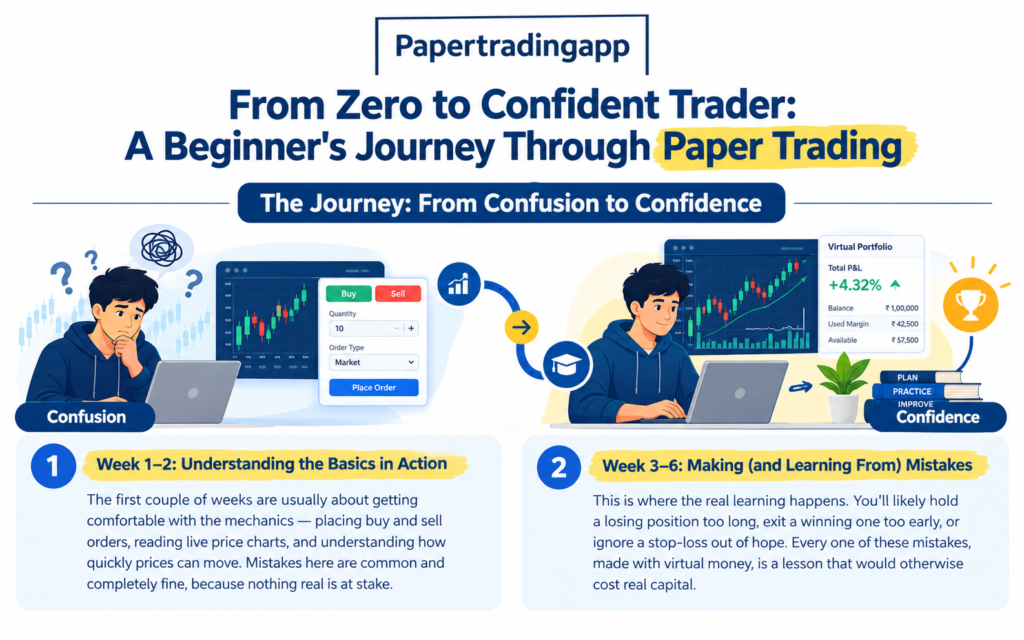
The Journey: From Confusion to Confidence
Week 1–2: Understanding the Basics in Action
The first couple of weeks are typically spent becoming familiar with the mechanics — placing orders and viewing real time price charts, and learning how fast prices may change. This is a place where it’s easy to make mistakes and it’s okay since nothing is real.
Week 3–6: Making (and Learning From) Mistakes
The learning is done in this area. You’ll probably hold on to a losing trade for too long and leave a winning one prematurely or before going to a stop-loss because you hope it will turn around. All of these mistakes were committed using virtual money and it would be a costly lesson learned if they were committed using real money.
Month 2 Onward: Developing a Repeatable Process
At this point, there are beginning to be patterns. You start recognising setups you feel comfortable trading and also you start to size your trades with greater regularity, and respond to short-term price action less emotionally. This is the transition from random response to market to trading with a real process.
What Confidence Actually Looks Like
Consistency Over Lucky Trades
Real confidence is not a single winning trade, it’s having the ability to repeat a good process over and over and over again over dozens of trades without regard to the outcome of each trade. One lucky win doesn’t teach you anything, one that is repeated and tried over and over teaches you everything.
Trusting Your Process Under Pressure
The last sign of a trader’s confidence is when the trade goes against him, he knows that the approach that he has already tried is successful and not depending on his hopes that it will work on him this time. So this is a calmness that can only be developed through repetition and practice and that’s what is offered by a simulator.
Conclusion
All successful traders have been beginners looking at their first candlestick chart. The distinction is, they offered themselves a chance to learn without putting themselves at risk of losing any real money. That’s the point of paper trading — to allow you to make the painful, costly trading mistakes in a safe, repeatable manner.
Frequently Asked Questions
Do I need any prior experience to start paper trading?
No — paper trading is designedfor complete beginners with zero prior market experience.
How realistic is paper trading compared to real trading?
It uses live NSE/BSE data, so price movements and order execution feel just like real trading, minus the financial risk.
How long does it take to feel confident as a trader?
Most beginners see meaningful improvement within 6–8 weeks of consistent practice.
Can I track my progress while paper trading?
Yes — good apps offer P&L tracking, win-rate stats, and trade journals to monitor your growth.
Is the best paper trading app in India free to use?
Yes, platforms like PaperTradingApp are completely free to download and use.
