
What if the most dangerous DeFi transaction is the one that succeeds exactly as intended? That question exposes a common weakness in cryptocurrency wallet security: users often judge a transaction by its destination, token amount, or network fee, while the real risk may be hidden in the contract instructions. A swap, bridge, mint, or approval can authorize far more than its short description suggests.
Transaction simulation addresses this gap by attempting to show what a transaction would do before it is signed. Rabby Wallet has become associated with this more explanatory approach to wallet design, particularly for users interacting with decentralized applications through a browser extension. Yet simulation is not a crystal ball. It is a useful security layer, not a substitute for understanding permissions, verifying websites, and protecting the signing device.
From “sign and hope” to pre-transaction analysis
Early cryptocurrency wallets largely treated signing as a binary event. The wallet could identify an address, display a fee, and request approval, but it often could not explain the economic meaning of complex smart-contract calls. That model was manageable when users sent simple transfers. It became inadequate as DeFi introduced automated market makers, lending protocols, yield strategies, non-fungible token marketplaces, and cross-chain bridges.
The central problem is that a blockchain transaction is not always a payment. It is frequently an instruction to a smart contract, which is software that can update balances, transfer assets, create permissions, or trigger additional contracts. A wallet user may see a familiar application and a button labeled “Confirm,” but the underlying call may include several operations. The interface’s plain-language summary can therefore be more important than the transaction’s appearance.
Transaction simulation works by evaluating a proposed call in an environment that approximates the current blockchain state. The wallet or its supporting infrastructure asks, in effect: if this transaction were executed now, which assets might leave the account, which assets might arrive, and which permissions would change? The result can help identify unexpected token transfers, suspicious approvals, failed execution, or a mismatch between the user’s intention and the contract’s behavior.
This is a meaningful conceptual shift. Security is no longer limited to checking whether the user recognizes the website. It also involves checking the expected state change. A user who intends to exchange one asset for another should be cautious if the simulated outcome shows an unrelated token leaving the wallet, a broad spending permission, or no meaningful return. The simulation turns an opaque signing request into a question about consequences.
Myths that make DeFi users overconfident
Myth: A familiar application makes every transaction safe
Recognition is useful, but it is not proof. A legitimate DeFi protocol can be integrated through a compromised front end, a malicious advertisement, a look-alike domain, or a deceptive token approval request. Even when the application itself is genuine, the user may be interacting with a new contract, an unusual function, or an asset whose behavior is difficult to interpret.
Simulation helps because it evaluates the proposed action rather than relying solely on the application’s reputation. Still, it depends on what the wallet can observe and interpret. A warning should be treated seriously, but the absence of a warning is not an independent guarantee that the website, contract, token, or economic strategy is sound.
Myth: “Unlimited approval” is the same as an immediate loss
An approval usually gives a contract permission to spend a specified token on the user’s behalf. An unlimited approval does not necessarily transfer the entire balance at the moment it is created. The more precise risk is that the approved contract may later spend tokens within the authorized scope, subject to the contract’s behavior and the token’s rules.
This distinction matters because it improves decision-making without minimizing danger. A user might reasonably approve a well-understood protocol for convenience, but that permission creates an ongoing relationship between the wallet and the contract. Revoking unused approvals can reduce exposure, although revocation itself is another on-chain transaction with a fee and must be verified carefully. Simulation can reveal that an approval is being created, but it cannot decide whether the user’s long-term risk tolerance justifies it.
Myth: A successful simulation proves a transaction is safe
Simulation is conditional. It describes what the system expects under a particular blockchain state, node response, and execution path. The state may change before the transaction is mined. A price can move, liquidity can disappear, a contract can behave differently under another caller or block condition, or a transaction can be reordered by network participants. A simulation may also be limited when a contract uses unusual logic, external data, private information, or interactions that are difficult to reproduce outside live execution.
There is also a difference between technical safety and economic safety. A simulated swap may complete without an obvious malicious transfer while still producing poor price execution, substantial slippage, exposure to a volatile asset, or an unfavorable lending position. In other words, “the transaction will probably execute” is not the same statement as “the strategy is sensible.”
What Rabby-style review can reveal
For a DeFi user, a useful review process begins with the intended outcome. Before signing, state the action in ordinary language: exchange a defined amount, deposit collateral, borrow a defined asset, claim a reward, or grant spending permission. Then compare that intention with the wallet’s transaction explanation and simulated balance changes.
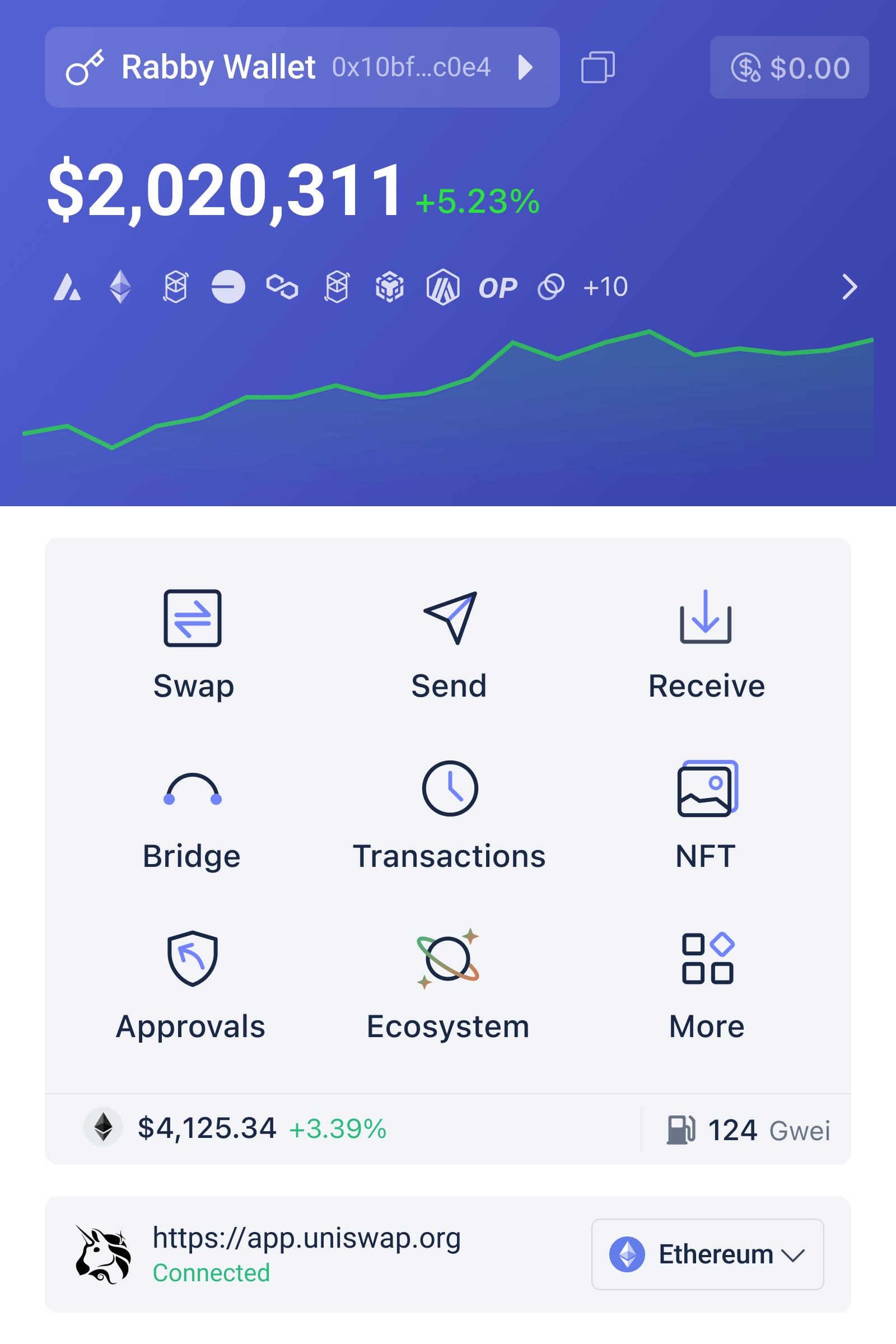
Rabby Wallet’s value in this context is best understood as contextual assistance. A browser extension can place contract information, warnings, network details, and expected effects closer to the signing decision. This is more informative than treating the wallet as a passive key holder. Users researching how to install the rabby extension should nevertheless verify that the download path is trustworthy, inspect requested browser permissions, and avoid entering a recovery phrase into any website or extension installation form.
Several signals deserve particular attention. A transaction that sends an asset when the user expected only to receive one is a clear reason to pause. A request to approve a large or unlimited token amount deserves a separate question: is this permission necessary, and is the contract address the one the user intended? A network mismatch, unfamiliar contract, unexpected gas payer, or warning about a potentially harmful interaction should not be dismissed simply because the transaction comes from a popular interface.
The most useful mental model is not “green means safe and red means dangerous.” It is closer to an airport checklist. Most routine checks do not prove that a flight will be trouble-free; they reduce the chance of overlooking a known failure mode. Likewise, transaction simulation can catch mismatches between intention and effect, but it cannot validate every assumption behind a DeFi decision.
The boundaries of simulation and wallet security
Simulation also has an infrastructure dependency. A wallet generally relies on network data and one or more remote services to estimate or interpret the transaction. If those services are unavailable, delayed, misconfigured, or incomplete, the explanation may be less useful. This does not make simulation pointless; it clarifies that the feature is part of a larger technical chain rather than an isolated property of the wallet interface.
Smart contracts create another boundary. Some contracts are deterministic and transparent enough for meaningful pre-execution analysis. Others use upgradeable components, complex callbacks, oracle prices, cross-chain messaging, or permission systems that are difficult to summarize in a compact warning. The transaction may be simulated correctly at a narrow technical level while the broader protocol risk remains unresolved.
Wallet security therefore has layers. The private key must be protected, the browser environment should be kept clean, the correct network and account must be selected, and the website address must be checked independently. Users should separate routine activity from high-value activity where practical, consider hardware signing for larger balances, and avoid signing when the wallet’s interpretation conflicts with the application’s explanation. These habits may feel slower, but speed is often the wrong optimization when an irreversible transaction is involved.
For US users, the practical lesson is especially relevant because DeFi access is commonly mediated through browser-based interfaces, multiple networks, and a changing set of token permissions. Consumer expectations shaped by conventional finance do not transfer neatly to self-custody. There may be no central institution that can reverse an erroneous approval or reimburse a mistaken transfer. A wallet’s warning system can improve the decision, but responsibility remains distributed across the user, the interface, the contract, and the underlying network.
A reusable checklist before signing
Use a short sequence rather than relying on intuition. First, identify the exact asset and amount leaving the wallet. Second, identify what the wallet expects to receive or what state will change. Third, inspect whether the transaction grants a continuing approval. Fourth, confirm the network, contract context, and account. Fifth, ask whether the simulated outcome still makes sense if the website’s marketing language is removed.
That final question is surprisingly powerful. DeFi interfaces often frame actions in terms of rewards, yield, or convenience. The wallet review strips away much of that framing and returns the decision to its mechanical core: assets move, permissions expand or contract, and a contract is called. If the mechanical description is unclear, the correct response is not to sign faster. It is to investigate or abandon the transaction.
Future wallet security will likely depend on better explanations, not merely more warnings. If simulation becomes more accurate across complex protocols and users learn to distinguish execution risk from investment risk, wallet interfaces could become an important form of financial literacy. That outcome is conditional, however. It requires transparent limits, careful user behavior, and continued scrutiny of the services that produce transaction interpretations.
Frequently asked questions
Does Rabby Wallet guarantee that a DeFi transaction is safe?
No. Transaction simulation and risk warnings can expose suspicious effects, unexpected transfers, and approval requests before signing. They cannot guarantee that a protocol is solvent, a token is valuable, a website is genuine, or a future blockchain state will match the simulated state. Treat the feature as decision support rather than insurance.
What should I do if the simulated result differs from what I expected?
Do not sign immediately. Check the selected network, account, contract, token amount, and approval scope. Reopen the application through a verified route and compare the action again. If the mismatch remains unexplained, reject the transaction. In self-custody, declining an uncertain transaction is usually cheaper than trying to repair an irreversible mistake.
Is transaction simulation enough to protect a wallet?
No. It should be combined with secure key management, careful website verification, browser hygiene, sensible approval practices, and a clear separation between high-value and routine activity. Simulation improves visibility into a proposed action, but it does not remove phishing, smart-contract, market, or operational risk.
